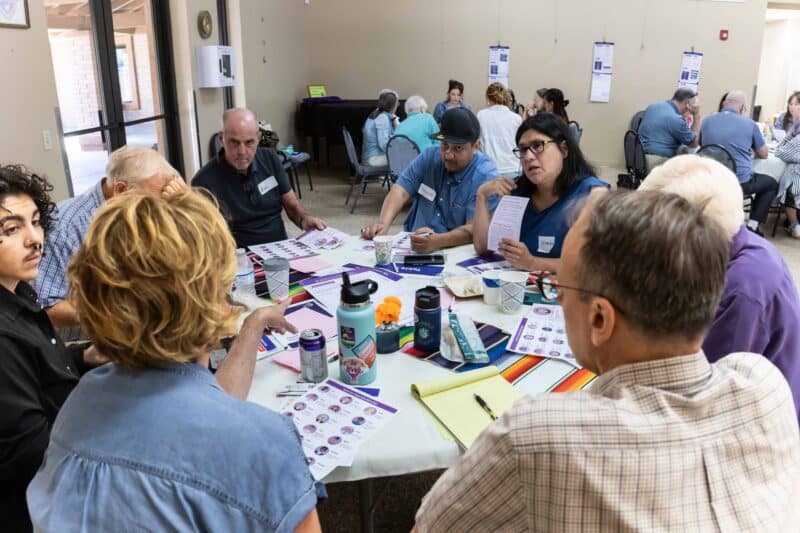

Our forum in Phoenix, AZ brought 56 community members to the Arizona Science Center to discuss nuclear waste management. At these forums, community members shared their priorities for collaboration between communities and the United States Department of Energy about building an interim nuclear waste storage facility. These community members worked individually, in table groups, and as a full group to share their perspectives. Check out some preliminary results below.
Most of the charts below are based on group responses from each of ten tables. However, some survey results show individual responses. In late 2025 or early 2026, we’ll publish a more complete results report from the forum in Phoenix and the other forums we host.
What are forums and why are we doing them?
3CAZ’s public forums are day-long discussions where people throughout Arizona are guided through facilitated activities to share their perspectives on nuclear waste management.

Community Values
One of the first activities asked attendees to decide on four core values that guide how their group makes decisions about the future. Below are all the values that each table contributed. You’ll notice that six tables included values related to respect as a shared value, making it the most common value across all tables. Values related to empathy and compassion figured quite prominently, alongside values like accountability, trust, and responsibility.
Priorities for Collaboration
In their table groups, community members ranked their top priorities for community collaboration. They were provided with priorities generated by the 3CAZ team through earlier consultations with AZ communities, nuclear waste experts, and other stakeholders. Across the ten tables in Phoenix, the Environment was by far the highest rated priority, followed by Facility Monitoring & Security and Human Health. Notably, every table but one listed build measures to protect local ecosystems and water resources, part of the environment category, as a top priority with six of ten tables listing it as one of their top three priorities. Access to research about radiation and human health was listed by seven of ten tables, while presence of adequate healthcare professionals and facilities was listed by eight of ten tables. The highest rated priorities related to facility monitoring and security included build up emergency management and security capacity and independent or community-led monitoring of safety at a waste storage facility.
Notably, Transparency was ranked lower by tables in Phoenix than by participants at the youth forum in Tempe, the Parker community forum, and the forum in Flagstaff. At all three of those forums, Transparency was the second highest rated category. It was the fourth highest rated in Phoenix. Over the coming weeks, we’ll be sharing results and comparisons from more forums. Check back for more!
Oversight & Involvement
As table groups worked through nuanced discussions about their values and priorities, they were tasked with applying their ideas to concrete choices about who should oversee decisions about nuclear waste management and a collaborative-based process for siting a nuclear waste storage facility at the federal and community levels.
Federal Level Oversight
Facilitators provided their table groups with a set of 6 oversight bodies: the US Department of Energy, Independent Federal Government Organization, Nonprofit Organization, Nuclear Energy Industry, Independent Scientists and Researchers, and Elected Leaders (county, state, tribal, and municipal governments). They then asked their table group members to decide together who, at the national level, they would want to oversee nuclear waste management and a collaborative process for siting a nuclear waste storage facility. While each table’s response was different, all ten tables selected Independent Scientists & Researchers, while six of ten tables selected the US Department of Energy and Elected Leaders.
Community Level Involvement – Decision Making Board
Later in the day, each table deliberated on who from a community they would want involved in day-to-day decision making within a community about siting an interim waste storage facility. Attendees reviewed 18 potential people as part of this activity. They also had the opportunity to create their own people cards. In the visual below, you can look at who was included in the decision making board most frequently.
Eight of ten tables said that an environmental scientist and a state environmental regulator should be on the Decision Making Board. Participants explained that each of these people are important to have on the Decision Making Board because of their environmental expertise and knowledge. One group explained they wanted the state environmental regulator involved because that person brings “integrity” to the board while two others stated the regulator can ensure rules and regulations are followed. The emergency planner was listed by seven of ten tables given their expertise and experience. Finally, six of ten tables included the following: Nuclear power plant supervisor, federal agency representative, and city mayor or council member. Tables pointed to a mayor’s connection to constituents and values as an important reason to include them. These selections were broadly similar to those in Flagstaff and Parker.
Community Level Involvement – Community Advisory Council
After deciding on their decision making board, each table group used the remaining people cards to select members of a Community Advisory Council that would oversee the Decision Making Board and a collaborative process for siting an interim nuclear waste storage facility.
Eight out of ten tables included a first responder in their community advisory council. Tables referenced the trust that communities put in first responders and noted they could provide an important connections to the community. Seven out of ten tables included the leader of a civic organization on their council citing this persons knowledge of the community as an important factor. Community resident was included by six of ten tables. One table noted that the community resident “does not have expertise…” but has lived in the community can “represent family needs.” Finally, half of the tables included the neighboring Tribal council leader on their councils. As in the forums in Flagstaff and in Tempe with youth, tables stated it was important to consider Tribal interests and noted that a Tribal council leader would bring valuable knowledge about the larger community’s values to the group.
Post Survey Results
Just as in our other forums, we asked community members at the Phoenix forum to complete a few survey questions so we could learn more about their perspectives and evaluate how the forum itself went in the eyes of participants.
Forums are meant to both inform community members about the topic while also providing them an opportunity to share their perspectives and learn from others. To understand if participants felt informed about the topic after the forum, we asked participants if they agreed or disagreed with the following statement, “I know enough about ______ to make an informed opinion about where a nuclear waste storage facility is built and how that decision is made,” where the blank was a five different topics (see chart below). As shown in the charts below, less than half of participants agreed they knew enough about the various topics listed before the forum. That figure was about 80% after the forum, suggesting that participants felt more informed after the forum than before.
Now let’s turn to whether or not participants felt they were able to share their perspectives. More than 90% of participants agreed to some degree that they were able to share their perspectives, that all participants had the same opportunities to share their perspectives, and that their views were represented in their groups’ responses (see chart below). Further, 75% of responses disagreed to some degree with the statement “I felt pressure to agree with something I wasn’t sure about,” suggesting that most participants felt the compromises or choices their group made did not undermine their own perspectives. These post survey results suggest that our goals for the forums–offering an opportunity to share perspectives while also learning about the topic–were met.
The last chart shown above summarizes responses to the following question: Ho much do you trust the federal government, local government, scientists, and non-profit organizations to respond to public needs? Scientists were by far the most trusted of the four entities listed with about 75% of participants stated they trusted scientists a lot or a great deal. The federal government received the lowest ratings, with 16 participants stating they didn’t trust the federal government to respond to public needs at all. These responses are generally similar to responses from the forum we conducted with youth in Tempe.
Demographics of Attendees
The charts below provide an overview of attendees’ demographics.