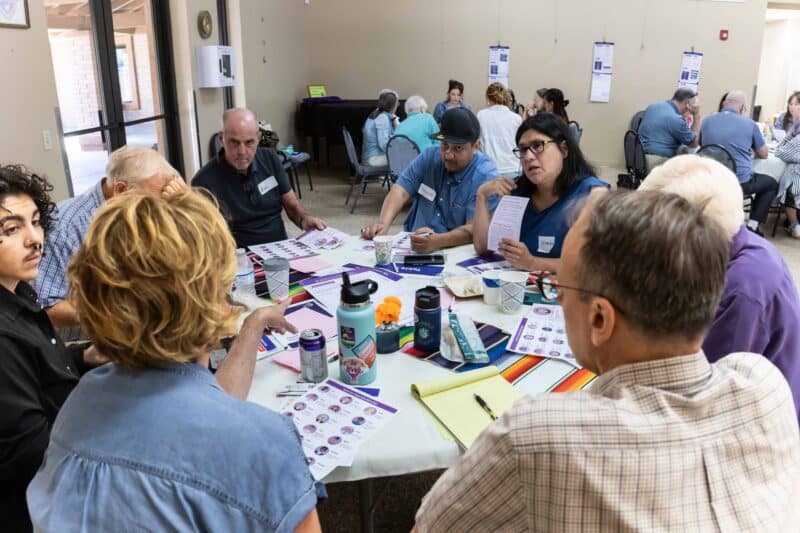

3CAZ worked with the SciTech Institute to host two forums for youth (14-18 years old) in Tempe. A total of 49 participants and 8 facilitators participated in the forum (and avoided the Tempe summer heat). They were divided into 11 different tables across two days. Participants came from across the Valley and the surrounding area.
As with our other forums, participants worked individually and in groups to share their perspectives through deliberative forum activities. Unlike our other forums, we skipped one session of the forum–session 2 on community values–due to scheduling constraints. Read on for a brief summary of the preliminary results!

What are forums and why are we doing them?
3CAZ’s public forums are day-long discussions where people throughout Arizona are guided through facilitated activities to share their perspectives on nuclear waste management.
Priorities for Collaboration
In their table groups, community members ranked their top priorities for community collaboration. They were provided with priorities generated by the 3CAZ team through earlier consultations with AZ communities, nuclear waste experts, and other stakeholders. Across all 11 tables, Environment ranked the highest as an overall category of priorities, followed by Transparency and Facility Monitoring & Security. The chart below shows average ranking of the categories of priorities, as well as the ranking of each individual priority. Overall, build measures to protect local ecosystems and water resources was the highest ranked individual priority; every table listed this priority as one of their top 12 and the lowest it was ranked was 6. Its average rank was 10. All but one table ranked agree on guidelines and rules for all parties involved, part of the Transparency category. Testing and demonstration of cask and facility safety and security and build up emergency management and security capacity were both included in the top 5, showing the group’s concerns about the safety and security of an interim waste storage facility. Interestingly, no table ranked decisions made by elected leaders in their top 12, but many groups included elected leaders in the “Who Should Be Involved?” activity. Taken as a whole the top priorities suggested the group was concerned about health and environmental impacts, preparedness measures, and transparency in the process and the information used to make decisions.
Oversight & Involvement
As table groups worked through nuanced discussions about their values and priorities, they were tasked with applying their ideas to concrete choices about who should oversee decisions about nuclear waste management and a collaborative-based process for siting a nuclear waste storage facility at the federal and community levels.
Federal Level Oversight
Facilitators provided their table groups with a set of 6 oversight bodies: the US Department of Energy, Independent Federal Government Organization, Nonprofit Organization, Nuclear Energy Industry, Independent Scientists and Researchers, and Elected Leaders (county, state, tribal, and municipal governments). They then asked their table group members to decide together who, at the national level, they would want to oversee nuclear waste management and a collaborative process for siting a nuclear waste storage facility. While each table’s responses were different, every table but one included Elected Leaders, while 8 of 11 tables included Independent Scientists and Researchers. Participants noted that Independent Scientists and Researchers, along with the Nuclear Energy Industry and the US Depart of Energy, have important expertise and experience with the topic. Elected Leaders were chosen to represent the values of communities. As one group wrote, “We chose these because it created a good balance between experts that know what they are doing and people who know about their community wants.” (This group chose, in no particular oder, the US Department of Energy, Independent Scientists and Researchers, and Elected Leaders).
Community Level Involvement – Decision Making Board
Later in the day, each table deliberated on who from a community they would want involved in day-to-day decision making within a community about siting an interim waste storage facility. Attendees reviewed 18 potential people as part of this activity. They also had the opportunity to create their own people cards. In the interactive visual below, you can look at who was included in the decision making board most frequently. Notably, the Nuclear Industry Representative, the Nuclear Power Plant Supervisor, and the State Environmental Regulator were included on 8 of the 11 table responses. The inclusion of these three people along with the Environmental Scientist (7 of 11) shows the importance the group placed on expertise and experience. Some groups noted that including the Federal Agency Representative was important to connect the community to the federal government. Finally, many groups (7 of 11) included the State Elected Representative as a way to represent the needs of the community to this decision making board.
Community Level Involvement – Community Advisory Council
After deciding on their decision making board, each table group used the remaining people cards to select members of a Community Advisory Council that would oversee the Decision Making Board and a collaborative process for siting an interim nuclear waste storage facility. You can see who was included most frequently in the interactive visual above. Participants noted that the four people who came up most frequently were well connected within the community, sought to represent and involve the community, and looked after the community’s safety. Groups referenced the Neighboring Tribal Council Leader as important to include to represent Tribal interests and concerns and because of their leadership experience. Many groups referenced the Local Chamber of Commerce President’s skills related to workforce and economic development as important to include in the advisory council. Groups also referenced the First Responder’s and Doctor’s care for the community’s well-being and their status as community leaders or people who can bring others together as important.
We’ll add more data and results to this over the coming days! Check back soon for more.