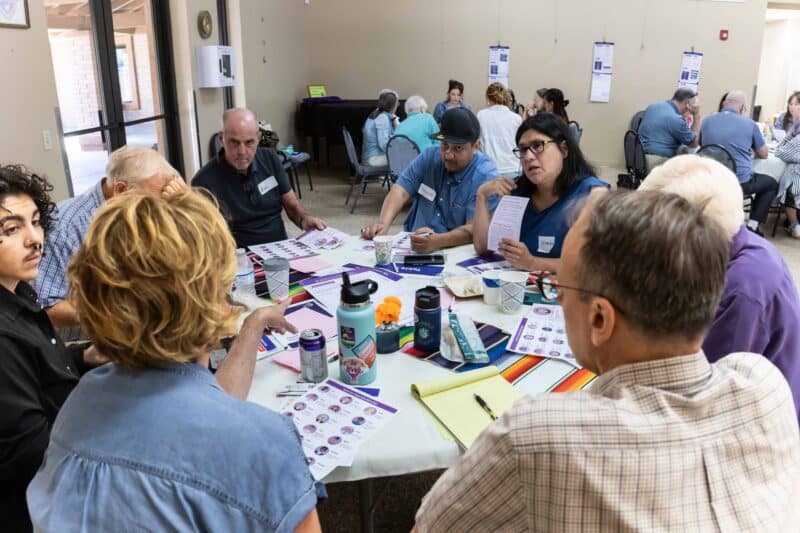

On a sunny Saturday morning in May, seventeen community members came to the Parker Public Library for 3CAZ’s first public forum. Throughout the day, those community members engaged in informed, facilitated discussions and activities at three tables. They shared their priorities for collaboration between communities and the United States Department of Energy on where to build an interim nuclear waste storage facility. They worked individually, in table groups, and as a full group to share their perspectives. Below is a brief summary.
Most of the charts are based on group responses from each of the three tables, though some of the survey results shows individual responses too. In late 2025 or early 2026, we’ll publish a more complete results report from the forum in Parker and the other forums we host.

What are forums and why are we doing them?
3CAZ’s public forums are day-long discussions where people throughout Arizona are guided through facilitated activities to share their perspectives on nuclear waste management.
Community Values
We asked each table group to determine what core values might guide how they make decisions about the future and what they value when making decisions about the future. Each table group had at least two values in common with another table group. Those values were education, honesty, and accountability. Teamwork and collaboration were also mentioned, which are similar in nature. You can check out all the values expressed by the Parker participants in the word cloud below. These values informed each table group’s discussion on their top priorities for a collaborative process.

Priorities for Collaboration
In their table groups, community members ranked their top priorities for community collaboration. They were provided with priorities generated by the 3CAZ team through earlier consultations with AZ communities, nuclear waste experts, and other stakeholders. Across all 3 tables, attendees selected priorities related to human health and the environment the most. In the human health category, all 3 tables selected access to research about radiation and human health, and 2 tables selected the presence of adequate healthcare professionals and facilities. In the environment category, all tables selected building measures to protect local ecosystems and water resources as a key priority. Transparency, facility monitoring & security, and economy received equal prioritization across the table groups. Importantly, 1 group wrote in their own priority, which was “consistent updates with amendments for proposals.” The rank of each priority for community collaboration is displayed in the bar chart below.

Oversight & Involvement
As table groups worked through nuanced discussions about their values and priorities, they were tasked with applying their ideas to concrete choices about who should oversee decisions about nuclear waste management and a collaborative-based process for siting a nuclear waste storage facility at the federal and community levels.
Federal Level Oversight
Facilitators provided their table groups with a set of 6 oversight bodies: the US Department of Energy, Independent Federal Government Organization, Nonprofit Organization, Nuclear Energy Industry, Independent Scientists and Researchers, and Elected Leaders (county, state, tribal, and municipal governments). They then asked their table group members to decide together who, at the national level, they would want to oversee nuclear waste management and a collaborative process for siting a nuclear waste storage facility. While each table’s responses were different, all tables included Independent Scientists and Researchers as a group they wanted involved in oversight. The groups explained that scientists and researchers “have experience firsthand with the research and function of the nuclear waste product” and groups noted they “didn’t want the gov’t to make major/all decisions” because they wanted decisions to be collaborative. In addition to scientists and researchers, tables included a Nonprofit Organization (1 table), Elected Leaders (2 tables), and the Nuclear Energy Industry (2 tables) as groups they wanted involved in oversight at the national level.
Community Level Involvement – Decision Making Board
Later in the day, each table deliberated on who from a community they would want involved in day-to-day decision making within a community about siting an interim waste storage facility. Attendees reviewed 18 potential people as part of this activity. They also had the opportunity to create their own people cards. If we put together all table groups’ responses, the people in the image below would make up the Parker Forum’s Decision Making Board.

Notably, all three tables agreed that a nuclear power plant supervisor is important to include in the board because of their expertise. They saw the nuclear plant supervisor as “someone who is a specialist” and “knows what to expect.” All tables also wanted a state environmental regulator on the board to enforce accountability and to help present and address risks. Two of three tables included an environmental scientist, an emergency planner, and a city mayor or council member on their decision making board due to their expertise and ability to represent and protect their community.
Community Level Involvement – Community Advisory Council
After deciding on their decision making board, each table group used the remaining people cards to select members of a Community Advisory Council that would oversee the Decision Making Board and a collaborative process for siting an interim nuclear waste storage facility. Looking across the Community Advisory Council’s created by each table group, four people stood out. Three table groups included a first responder in their council for the safety of the community and because they are on the “frontlines” of the community and they “care about members of [the] community.” Additionally, all tables included a community librarian on their council because libraries are a “centralized point for community resources.” (Side note: The inclusion of the community librarian in all tables’ responses was not lost on our excellent library hosts. It also speaks to how important the library and its programming is to the larger Parker community). Two table groups also selected a neighboring tribal council leader and community youth to ensure broad representation.

Learning and Trust
Finally, we asked attendees a few survey questions before and after the forum so we could learn more about their perspectives. Here are a few things that stood out to us as adding additional depth to the results discussed above.
First, we wanted to learn more about trust and how it may play a role in our forum participants’ decision-making. We asked attendees how much they trusted various entities to respond to public needs. Parker community participants responded that scientists were more trusted than the federal government, state government, and nonprofit organizations, as most participants reported that they trust scientists either “a lot” or a “great deal” to respond to public needs. Nonprofit organizations received a fair amount of trust, since most participants reported that they trust these organizations either “a moderate amount” or “a lot.” And finally, the federal government and state government received some trust; most participants reported that they trust these two entities either “a little” or “a lot.” Overall, trust in scientists seems to align well with the Parker community participants’ value toward expertise that was conveyed when each table selected Independent Scientists and Researchers as a group they want to be involved in federal oversight, mentioned above.

Second, we wanted to learn a bit more about how the Parker community participants perceived the forum and what it might mean for future forums. Responses to two of our questions stood out to us. The first is about whether the forum participants felt they knew enough about the forum topics to make an informed decision. The forums are meant to be informed dialogues where participants learn about the topic through videos, table top activities, and a background information document. This learning gives participants a shared foundation to support their deliberations. To see whether or not this worked, we asked participants to assess their knowledge of the forum topics before and after the forum. Check out the results in the figures below! Our key takeaway was that participants’ reported knowledge of forum-related topics was quite varied before participating in the forum, but after the forum, the majority of participants agreed to some extent that they knew enough about each topic to make an informed opinion about it. This signals that the information we are providing participants is supporting them in the ways we intended.


Demographics of Attendees
The charts below provide an overview of attendees’ demographics.